"The World is a book, and those who do not travel read only a page." - Saint Augustine
Though our trip in 2006 was planned because of the horses, we decided to take time to explore a bit of Warsaw while in Poland! We always try to do that.....even when we go to horse shows, etc. We take care of business, then take time to enjoy the journey as well, by exploring our surroundings! Farming and animals will show you a lot of the world, if you only take the time to see it as you go! This blog will have mostly pictures for you to enjoy. When I have a little bit of history to share, I will certainly do that as well.
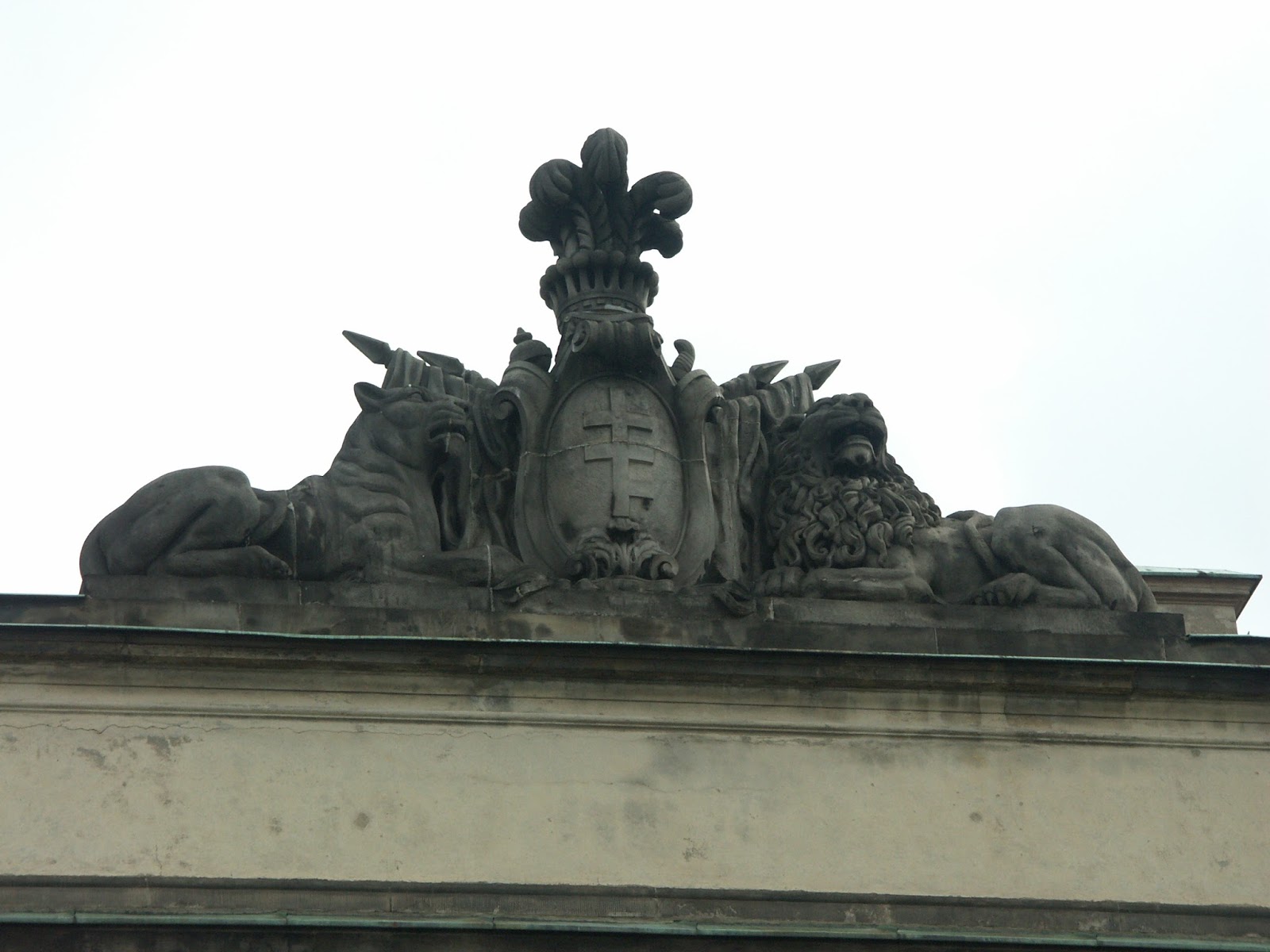
I loved the stone carvings and architecture of Warsaw! Simply beautiful!
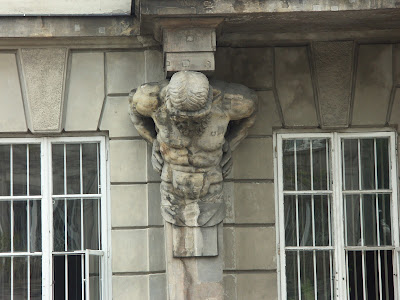 |
| Close up of the stone carving on the building front in above picture. |
 |
| Water spouts at a public fountain. |
 |
| Guard duty. |
 |
| The beautiful interior of the Church of St Kazimierz. |
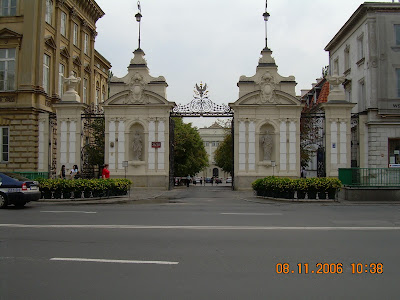 |
| Entrance gates of the University of Warsaw. |
The Church of the Holy Cross is on the main road that leads to the Castle Square. It is very elaborate and beautiful, but is also known for a very unique item.....on the first large column to the left, inside the church, is a memorial plaque. This is the location of Chopin's heart! He was originally from Poland and though his body is buried in Père Lachaise Cemetery in Paris (where he died), his heart lies sealed in an urn in this church. The urn was placed behind a tablet bearing his likeness (the tablet was specially carved by Leonardo Marconi). Chopin asked that before he was buried, he wanted his heart removed. It seems he was scared of being buried alive! His eldest sister knew of his wishes and when she arrived in Paris after his death, she asked permission to take his heart back to Poland with her. She made sure the heart was preserved in a sealed crystal jar filled with an alcoholic liquid (possibly cognac). This, in turn, was encased in an urn made of mahogany and oak. She then brought this back to Poland in early 1850, a few months after her brother’s death. In 1879, it was placed inside the Holy Cross Church.
Other points of interest inside the church is the organ, built in Salzburg in 1925 and reported to be the largest organ in Warsaw. There is an urn with the remains of Nobel Prize author Wladyslaw Reymont and tablets honoring other famous Poles, such as poet Juliusz Slowacki and WWII hero Wladyslaw Sikorski.
Following are pictures of the Church of the Holy Cross.
 |
| This statue of Jesus carrying the cross, is in front of the church and still bears bullet holes from WWII. |
 |
| The alter inside the church. |
 |
| Chopin's memorial, where his heart is located. |
Below is a picture of the statue honoring Dr Henryk Goldszmit (aka Janusz Korczak). This one is located near the Palace of Culture and Science in Warsaw. He was a doctor, teacher, writer and humanitarian who ran an orphanage for Jewish children in Warsaw during the Holocaust. He was offered safety through the Polish Underground, but chose to remain with his 190 orphan children instead. He went with them to Treblinka and was killed there, with them, in August of 1942.
Some local sights follow. The Royal Route, a local flower market, a picture inside a local market and you gotta have fast food, right? A Kentucky Fried Chicken franchise fills the need.
 |
The Royal Route.
|
 |
Local flower market.
|
 |
| A look inside a local market. |
 |
A Kentucky Fried Chicken franchise in Warsaw.
|
The Tomb of the Unknown Soldier is located where the Saxon Palace used to stand. It is the only part of the Palace that is left. It burns an eternal flame in memory of unknown Polish soldiers, who gave their lives for their country. The changing of the guard takes place every hour, on the hour, every day of the year. On November 2, 1925, an unidentified body of a young soldier who died during the Defense of Lwow was placed in the tomb. Since then, earth from numerous battlefields where Polish soldiers have fought has been added to the urns that stand in the location. The pillars are the last surviving parts from the Saxon Palace. In times gone by, they formed the arcade that linked the two symmetrical wings of the Saxon Palace.
 |
| A military ceremony at the Tomb of the Unknown Soldier. |
 |
| Guards at the Tomb. |
 |
| Guards at the Tomb. |
 |
| Guard on duty at the Tomb of the Unknown Soldier. |
The Tomb of the Unknown Soldier is located in the Saxon Gardens. The Gardens face Pilsudski Square and are a popular spot for outdoor relaxing! They feature a gorgeous fountain and rows of statues and sculpted flower beds. The Saxon Palace used to be located here as well (in the area of the Tomb of the Unknown Soldier). The Palace was destroyed by German bombs in 1944 and was never rebuilt. An interesting note about the Palace, it was there, in 1932, that the German Enigma code was first decoded! There used to be a high school in this area as well. Chopin's father taught French in that school. The following are pictures of the Saxon Gardens.
 |
| The arches you see are the Tomb for the Unknown Soldier. |
 |
| The arches are the Tomb of the Unknown Soldier. |


The Palace of Culture and Science is the tallest building in Poland, standing at 778 feet! Construction began on the building in 1952 and took 3 years to complete. It was originally called the Joseph Stalin Palace of Culture and Science, but Stalin's name has now been removed. The building has hosted various festivals, pageants and concerts in it's lifetime. One of them was the Rolling Stones concert in 1967. This was the first major western rock group to perform behind the Iron Curtain! Today the building houses various companies, cinemas, theaters, libraries, sports clubs, universities and scientific institutions. It is Warsaw's most visible landmark. However, the building has been controversial from it's beginning. Some thought it took away from the balance of the old city and others felt it was a symbol of Soviet domination. Some of those negative feelings persist still today. In 2010, exterior lighting was added to the building and it now can be lit up at night for various events. The following are all pictures of the building we took in 2006.


The Staszic Palace was originally built in 1620! It has underwent many make-overs and rebuilds, the most recent having occurred after it was nearly destroyed during the 1944 Warsaw Uprising. It was rebuilt during 1946 to 1950. Today it houses the Polish Academy of Sciences.
 |
| Staszic Palace |
The statue of Nicolaus Copernicus stands in front of the Staszic Palace. He is the founder of modern astronomy and is one of the most well known scientists that came from Poland. The statue was unveiled in 1830. During WWII the Nazi's placed a bronze plaque near the statue that insinuated he was a German. In 1942 a boy scout, named Alek Dawidowski, got around the guards and removed the plaque. The Nazi's then removed the statue and hid it in Silesia. (Silesia is now a region of Central Europe located mostly in Poland, with small parts in the Czech Republic, Slovakia and Germany.) The statue was recovered after the war and returned.
 |
| Staute of Nicolaus Copernicus in front of the Staszic Palace. |
Adam Mickiewicz lived in Poland during the early 1800's. He was a poet, the man who inspired Romanticism in Poland and he was a patriot. He was exiled from Poland by the ruling Russians in 1824, never to return to his homeland again. He is thought of as Poland's greatest literary figure, as well as a symbol of hope for a Russian oppressed Poland during his time. Even though he is a national treasure, his personal life is shrouded in mystery. The place of his birth is not even known for sure and it seems his tastes for womanizing and involvement with odd cults have been covered up! He died in Turkey in 1855 during a cholera outbreak. His statue in Warsaw is riddled with bullet holes from WWII.
 |
Statue honoring Adam Mickiewicz in Warsaw.
|
Jozef Pilsudski's monument was finished in 1995. It stands in a square dedicated to him in Warsaw. It was designed by Tadeusz Łodzian and was cast in the Navy shipyard in Gdynia, Poland. Most Poles give him credit for being the man to win Poland it's independence back from Russia, in 1918. He's a significant political and military Polish hero with an extensive resume. Between 1945 and 1989, any mention of Pilsudski and his record, were some of the multiple topics forbidden by the Polish communist regime.
 |
| Statue of Jozef Pilsudki. |
Another major statue of significance is that of Prince Jozef Poniatowski. It stands in front of the Namiestnikowski Palace (also known as the Presidential Palace). He was born in 1763 in Vienna. He was a Polish patriot and statesman, a general and army chief, a national leader and military hero of the independence wars period and he fought under Napoleon and became a Marshal of France. He was covering the French Army’s retreat at the Battle of Leipzig in 1813. He heroically defended the town but refused to surrender to the overwhelming enemy forces. He plunged into the Elster River there and died in its waters.
 |
| Statue of Prince Jozef Poniatowski in front of the Namiestnikowski Palace. |
 |
| Statue of Prince Jozef Poniatowski. |
That's all for our tour of Poland's capital for this week. Next week, we will visit Old Town in Warsaw. Have a great week everyone! I hope you enjoyed the pictures!